
EUR/USD may be the same currency pair everywhere, but the capital required to trade it can vary considerably from one broker to another. One platform might require 3.33% margin from a retail trader, while another account operating under a different regulatory framework may require only 0.5%.
The reason is that forex margin requirements are not determined by the currency pair alone. Regulation, client classification, broker risk controls, leverage limits, account type and even the size of the individual position can influence the amount of capital that must be set aside.
This is particularly important when comparing brokers. A lower margin requirement allows a larger position to be opened with the same account balance, but it also increases effective leverage and therefore increases the speed at which losses can affect account equity.
Understanding why forex margin requirements differ is more useful than simply searching for the broker offering the highest leverage.
What Are Forex Margin Requirements?
Forex margin requirements represent the amount of capital a trader must have available to open and maintain a leveraged currency position. Margin is not normally a separate trading fee. It is collateral reserved to support the position.
Suppose a trader wants exposure to $100,000 of EUR/USD. If the account allows leverage of 30:1, the initial margin would be approximately:
$100,000 ÷ 30 = $3,333.33
The same position at 200:1 leverage would require approximately:
$100,000 ÷ 200 = $500
The market exposure remains $100,000 in both cases. Only the amount of capital supporting that exposure changes. This is why forex leverage requirements and margin are directly connected. Higher permitted leverage produces a lower initial margin percentage.

Margin Percentage Forex and Leverage Are Two Ways of Expressing the Same Relationship
A margin percentage forex figure can usually be converted into an approximate leverage ratio.
For example:
| Margin Requirement | Approximate Maximum Leverage |
| 2% | 50:1 |
| 3.33% | 30:1 |
| 5% | 20:1 |
| 10% | 10:1 |
| 20% | 5:1 |
A trader seeing a 3.33% margin requirement is therefore effectively looking at maximum leverage of around 30:1 for that position. The reverse calculation works as well.
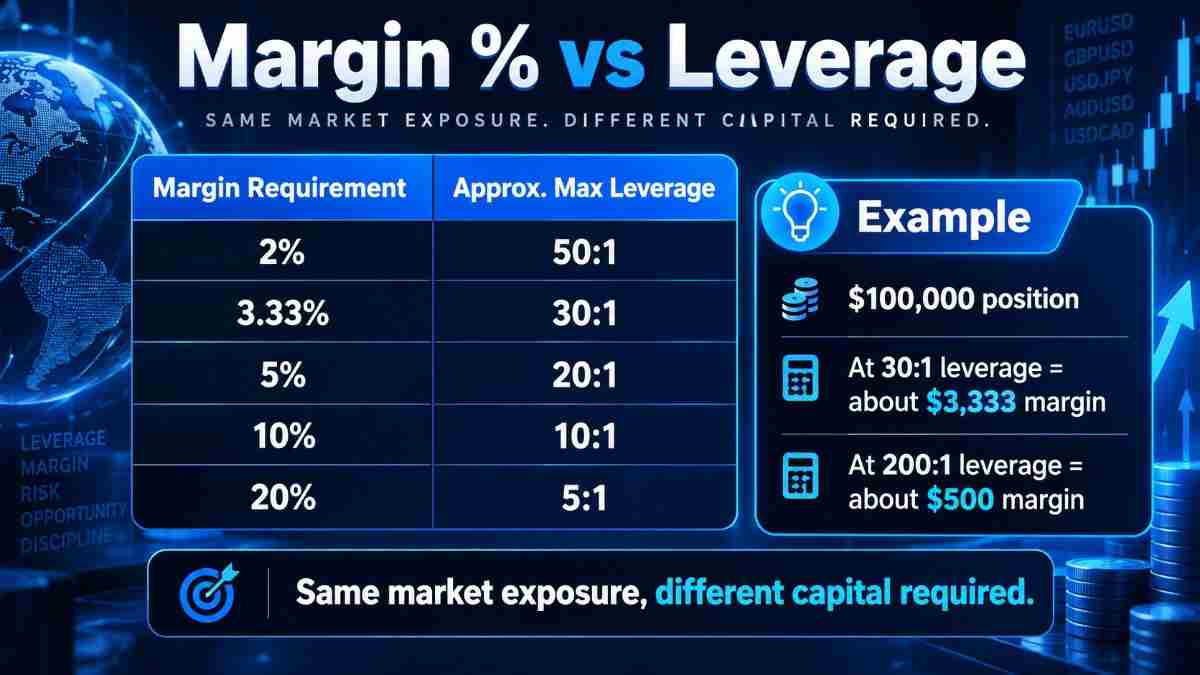
This relationship helps explain why two brokers can publish apparently different forex margin requirements while both are simply expressing the amount of leverage permitted under their particular rules.
Regulation Is One of the Biggest Reasons Margin Differs
Regulatory jurisdiction can materially affect currency pair margin. For UK retail CFD clients, the Financial Conduct Authority requires leverage to be limited between 30:1 and 2:1 depending on the underlying asset. Major currency pairs can receive the highest permitted retail leverage within that framework.
European measures introduced by ESMA similarly established maximum retail CFD leverage of 30:1 for major currency pairs and 20:1 for non-major currency pairs. A broker operating through another jurisdiction may permit substantially higher leverage.
That creates a straightforward reason why the same EUR/USD position can have very different forex margin requirements depending on which legal broker entity holds the account.
Major and Minor Currency Pairs Can Have Different Margin Requirements
Not all currency pairs receive the same treatment. Under the ESMA retail CFD framework, major currency pairs can receive leverage up to 30:1, whereas non-major pairs are limited to 20:1.
That means approximately 3.33% initial margin for a major pair compared with 5% for a non-major pair, before considering any stricter broker policy. The difference reflects risk.
Major currencies such as the U.S. dollar, euro and Japanese yen generally trade with deeper liquidity than many less frequently traded currencies. Some minor or exotic pairs can experience wider spreads and sharper moves, particularly during periods of market stress. A broker may therefore apply a higher currency pair margin to instruments it considers more volatile or less liquid.
Brokers Can Apply Stricter Rules Than the Regulatory Minimum
Regulation often establishes the maximum leverage a broker may provide rather than forcing the broker to provide that maximum. A company can choose stricter broker margin levels. For example, a regulatory framework might permit 30:1 leverage on EUR/USD, yet the broker may decide to offer only 20:1 to a particular client category. The resulting margin requirement would be higher.
Brokers manage their own exposure as well as client risk. During unusual market conditions, they may reduce leverage or raise required margin if an instrument is expected to become significantly more volatile.
This is one reason traders should check live contract specifications rather than assuming the margin shown months earlier still applies. TopTrendingBrokers’ FirstECN review illustrates how leverage can be published as part of a broker’s individual account conditions rather than as a universal industry figure.
Why Forex Leverage Requirements Change During Volatility
Forex leverage requirements can also become stricter around unusual market events. An election, central-bank announcement, referendum or unexpected geopolitical event can sharply increase currency volatility. A broker may respond by raising initial or maintenance margin on affected instruments.
This protects the broker from exposure while also reducing the amount of leverage clients can use during unstable conditions. The trader may notice that a currency pair previously requiring $500 of margin suddenly requires considerably more.
This does not necessarily mean the broker has permanently changed the account. Temporary adjustments can form part of margin trading rules designed for exceptional market conditions. The broker should explain its right to make such changes in the trading agreement or margin policy.
Position Size Can Change Forex Position Margin
Some brokers use tiered margin structures. Under this approach, a small EUR/USD trade may receive the lowest margin rate, while larger exposure receives progressively higher rates.
Imagine the first $1 million of exposure qualifying for one rate and additional exposure receiving a higher forex position margin requirement. This structure reflects the fact that liquidating a very large position can be more difficult than closing a small retail order.
A trader should therefore avoid calculating margin simply by taking the lowest advertised rate and applying it to any position size. The actual forex position margin can depend on the notional exposure already held in the account.
Account Type Can Affect Broker Margin Levels
Different accounts with the same broker may use different broker margin levels. A retail account may have regulatory leverage restrictions. A professional or eligible counterparty account can have different limits where local rules permit.
Offshore broker entities may also offer substantially different maximum leverage from the same group’s European or UK business. Some account structures are designed specifically for higher-volume or professional traders and may use separate risk controls.
TopTrendingBrokers’ TradeEU Global review and TradGrip review show how account conditions, maximum leverage and legal entities can vary from one provider to another. The key is to compare the exact account being opened-not the highest leverage number appearing anywhere on a broker’s website.
How Currency Pair Margin Is Calculated
The precise formula varies with the broker, but a simplified currency pair margin calculation often begins with notional exposure.
Assume a trader buys 100,000 EUR/USD at an exchange rate of 1.1000.
The position is worth approximately $110,000.
At 30:1 leverage:
$110,000 ÷ 30 = approximately $3,666.67 margin
At 100:1 leverage:
$110,000 ÷ 100 = approximately $1,100 margin
At 200:1 leverage:
$110,000 ÷ 200 = approximately $550 margin
This demonstrates why a lower margin requirement is not automatically an advantage. The trader controls the same $110,000 exposure with progressively less capital.
A relatively small adverse market move therefore consumes a larger percentage of the money supporting the position.
Initial Margin and Maintenance Margin Are Different
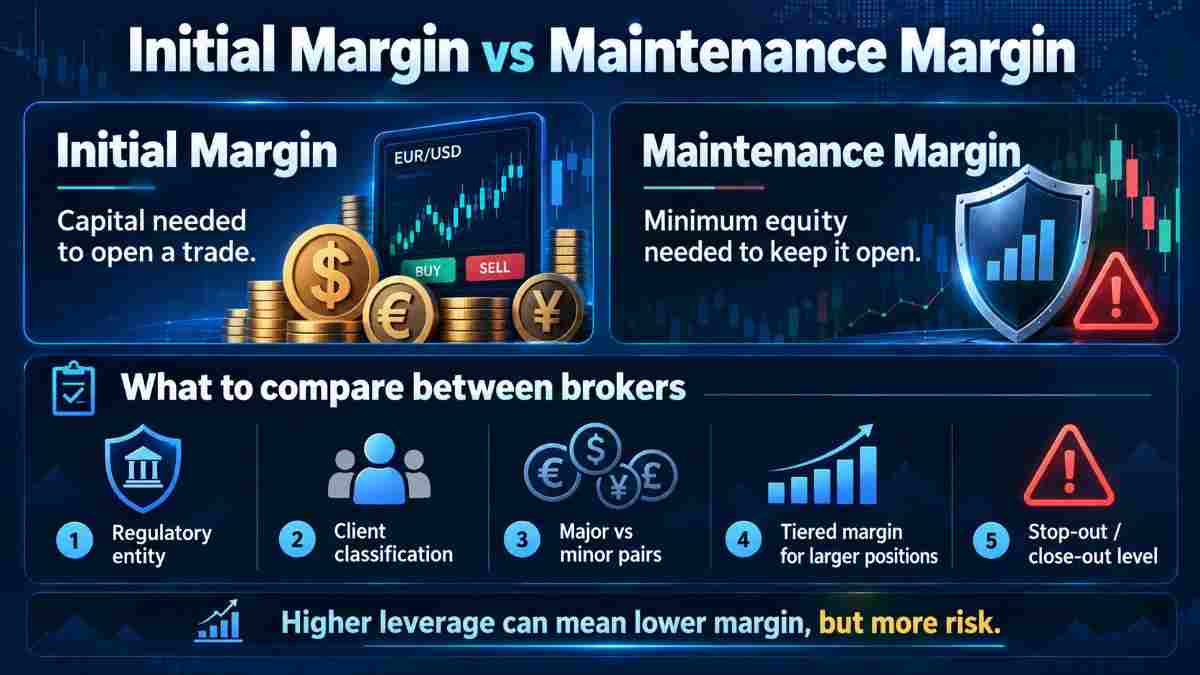
Forex margin requirements can involve more than the amount needed to open a position. Initial margin determines whether the trade can be opened.
Maintenance margin determines whether sufficient account equity remains to keep leveraged positions open. For UK retail CFD accounts, the FCA requires positions to be closed when account funds fall to 50% of the margin required to maintain open CFD positions.
This means the trader needs to understand both the opening requirement and the broker’s close-out rules. A platform advertising attractive leverage while providing unclear stop-out information gives an incomplete picture of account risk.
TopTrendingBrokers’ top trading platforms section can be used as a starting point when comparing broker platforms, but the specific margin policy should always be verified directly.
Why Professional Accounts Can Have Lower Margin Requirements
Professional classification can lead to different forex leverage requirements in jurisdictions where retail leverage caps do not apply in the same way. The attraction is obvious: lower margin allows more market exposure with the same capital.
The trade-off is that professional classification can also involve losing certain retail protections. A trader should therefore avoid switching classification only because the margin percentage forex figure looks more attractive.
Higher leverage does not improve the underlying trade. It simply changes how much exposure can be created with the available capital.
How to Compare Forex Margin Requirements Between Brokers
The most useful comparison is not simply “Broker A offers 1:30 and Broker B offers 1:200.” Check which regulatory entity provides the account, whether the leverage applies to your client classification, whether the same rate applies to all currency pairs and whether tiered margin is used for large positions.
Also review the stop-out level. A broker offering very high leverage may also use a close-out threshold that allows little room for adverse movement once the account becomes heavily exposed. Understanding the complete set of margin trading rules gives a much clearer picture than leverage alone.
Final Thoughts
Different forex margin requirements for the same currency pair are normal because brokers operate under different regulatory, account and risk-management frameworks. EUR/USD does not change because a trader switches broker, but the amount of leverage the broker is permitted or willing to provide can change substantially.
Regulation, pair volatility, client classification, position size and broker risk controls can all affect the required forex position margin. The lowest margin requirement should therefore not automatically be viewed as the best deal.
Less required margin means more leverage is available. That can increase trading flexibility, but it also makes it easier to build exposure that is too large for the account. Understanding forex margin requirements before opening a position is ultimately more important than simply choosing the broker displaying the largest leverage ratio.
Disclosure
This article is for educational and informational purposes only. It is not financial, investment, legal, tax or trading advice. Leveraged forex and CFD trading involves substantial risk and can result in significant capital loss. Margin and leverage rules vary by broker, jurisdiction and client classification. Always verify current requirements directly with the broker before trading.
FAQs
What are forex margin requirements?
Forex margin requirements are the amount of capital that must be available as collateral to open and maintain a leveraged currency position.
Why does currency pair margin differ between brokers?
Currency pair margin can differ because brokers operate under different regulations, leverage policies, account structures and internal risk controls.
What is margin percentage forex?
A margin percentage forex figure shows how much of a position’s notional value must be provided as margin. For example, 5% margin corresponds roughly to 20:1 leverage.
Why do broker margin levels change?
Broker margin levels can change because of volatility, regulatory requirements, account classification, position size or temporary risk-management measures.
What are forex leverage requirements?
Forex leverage requirements determine how much exposure can be controlled relative to the trader’s margin. Higher leverage normally means a lower initial margin requirement.
What is forex position margin?
Forex position margin is the amount of account capital reserved to support a particular leveraged trade or group of positions.
Can a broker increase margin on an existing currency pair?
Potentially, yes. Broker terms may permit margin changes in response to volatility, regulatory changes or other risk conditions. Traders should review the current margin policy of their specific account.
