
Leveraged trading can move quickly. A trader may place a stop-loss expecting a position to close at a particular level, only for a sudden market gap to push the next available price far beyond it. Without additional safeguards, that kind of move can theoretically leave a leveraged trading account below zero.
Forex brokers with negative balance protection are designed to address that risk. When the protection applies, the trader’s liability is limited according to the broker’s terms or the regulatory framework governing the account. In major retail CFD regimes such as the UK and EU, the protection limits retail clients from losing more than the funds held in the relevant CFD trading account.
That does not mean trading becomes risk-free. A protected account can still lose its entire available balance.
Understanding what negative balance protection does-and what it does not do-is therefore essential before selecting a broker.
What Is Negative Balance Protection Forex?
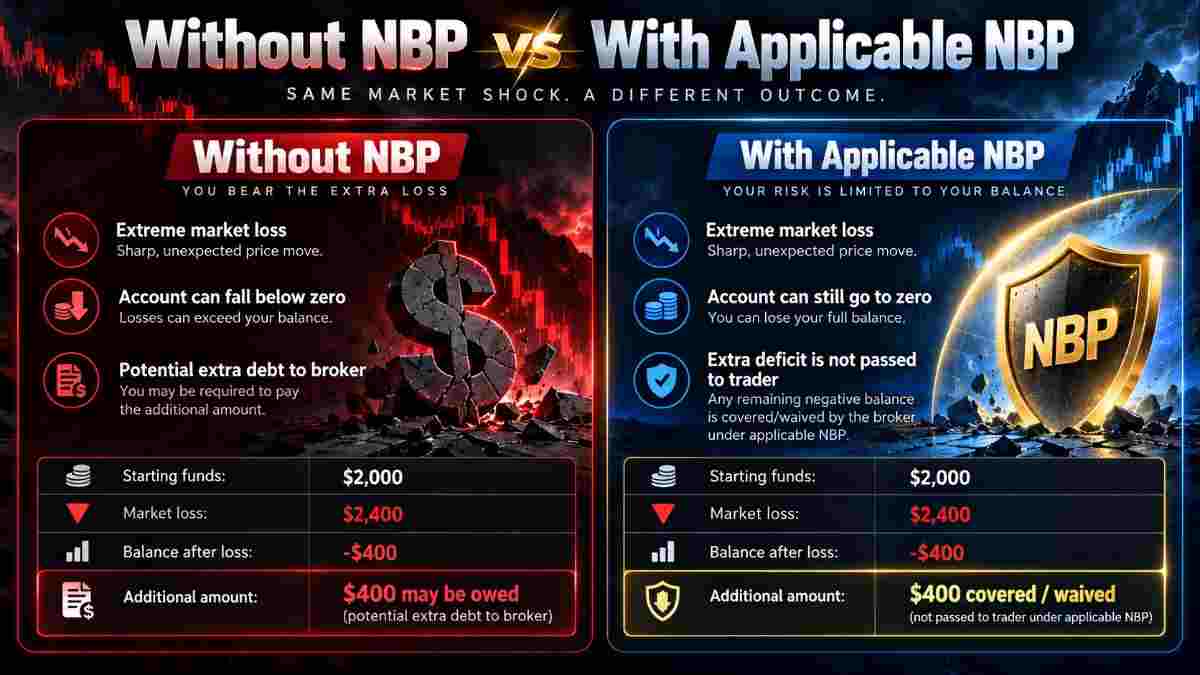
Negative balance protection forex refers to a safeguard that prevents a qualifying trading account from leaving the client responsible for losses beyond the protected account funds. Consider a trader with $2,000 in a leveraged CFD account.
An unexpected market event causes a position to gap sharply. Instead of closing with a $1,500 loss as expected, the available execution price would mathematically create a $2,400 loss.
Without protection, the account could show -$400, potentially leaving the client owing money to the broker.

With applicable negative balance protection, liability is restricted according to the relevant rules. The trader can still lose the $2,000 held in the account, but the additional deficit is not passed on as a debt where the regulatory protection applies.
The Financial Conduct Authority requires firms offering relevant CFDs to retail consumers to provide protection ensuring that clients cannot lose more than the total funds in the trading account.
This protection is one reason broker jurisdiction and client classification matter so much.
How Forex Broker Negative Balance Protection Works
Forex broker negative balance protection operates at account level in major UK and European retail CFD frameworks.
ESMA defines negative balance protection as limiting a retail client’s aggregate liability for all CFDs connected to a CFD trading account to the funds in that account. In other words, the trader cannot be required to cover losses exceeding the funds dedicated to CFD trading under that protection.

It is useful to distinguish this from other risk controls.
A stop-loss attempts to close an individual position at or around a selected price.
A margin close-out rule forces positions to be reduced when account equity becomes too low.
Negative balance protection deals with what happens if losses nevertheless exceed the protected funds.
These controls can work together but solve different problems.
The UK’s permanent CFD rules, for example, combine leverage restrictions, a 50% margin close-out threshold and negative balance protection for retail customers.
Why Can a Forex Account Negative Balance Occur?
A forex account negative balance is most likely during abrupt market movements when the next executable price is significantly worse than the price expected by the trader. Foreign exchange markets are usually highly liquid, but liquidity is not constant.
Major political announcements, central-bank surprises, weekend gaps or unexpected economic events can produce sudden repricing. Stop orders can then experience slippage.
Suppose a stop-loss is placed at 1.1000. If the market jumps directly from 1.1010 to 1.0950 with little or no executable liquidity between those prices, the position may close closer to 1.0950 rather than the intended 1.1000.
When leverage is high, such differences can be significant relative to the account balance.
Forex brokers with negative balance protection provide an additional layer of protection after normal stop-loss and margin mechanisms have failed to contain the loss within available account funds.
Negative Balance Protection Explained: A Simple Example
The easiest way to understand negative balance protection explained is through a simplified comparison.
| Situation | Without NBP | With Applicable NBP |
| Starting account funds | $2,000 | $2,000 |
| Extreme market loss | $2,400 | $2,400 |
| Mathematical balance | -$400 | -$400 |
| Client’s protected liability | Potentially $2,400 | Limited to protected account funds |
| Amount potentially owed beyond $2,000 | $400 | $0 under applicable protection |
This example is deliberately simplified. Actual account treatment depends on the broker agreement, product, jurisdiction and client status.
The important point is that broker protection against negative balance does not preserve the original $2,000. It addresses the additional $400 deficit.
The account can still be completely depleted.
Which Brokers With Negative Balance Protection Offer It?
The phrase brokers with negative balance protection should be interpreted carefully because protection can depend on the legal entity rather than simply the brand.
A large international broker may operate a UK-regulated company, an EU company and one or more offshore entities. The protections applying to a client can differ depending on which company actually holds the account.
For UK retail CFDs, negative balance protection is a regulatory requirement under FCA rules. The FCA states that relevant firms must provide protections guaranteeing that retail customers cannot lose more than the total funds in the account used for these products.
European measures introduced by ESMA likewise established negative balance protection on a per-account basis for retail CFD clients.
Outside those regimes, the situation can be different. Some brokers voluntarily offer similar protections, while others may provide them only for certain clients or accounts.
That is why traders should verify the exact legal entity rather than searching only for a brand name.
TopTrendingBrokers’ TradGrip review and TradeEU Global review illustrate why regulatory entity, leverage and account terms should be examined together when comparing brokers.
NBP Forex Brokers and Retail Client Status
NBP forex brokers do not necessarily provide identical protection to every customer.
The distinction between retail and professional clients is especially important.
The FCA rules discussed above apply specifically to retail consumers trading CFDs and similar restricted speculative investments. A professional client may not receive the same regulatory protections.
This creates an important consideration for experienced traders who are offered professional classification in exchange for different leverage or trading conditions.
Higher leverage can be attractive, but losing mandatory retail protections can materially change the account’s risk profile.
Before changing classification, traders should establish whether forex broker negative balance protection remains in place and whether it is a legal requirement or merely a contractual promise from the broker.
Negative Balance Protection Does Not Replace a Stop-Loss
A common mistake is to treat negative balance protection forex as a substitute for normal risk management.
It is not.
NBP is designed for an extreme outcome: losses exceeding the protected account funds. A stop-loss is designed to control the loss on a particular position before the account reaches that stage.
A trader risking half an account on one position does not become conservative simply because the broker offers negative balance protection.
Likewise, NBP does not guarantee that stop-loss orders will execute at the requested price.
Market gaps and slippage can still happen. The protection addresses the resulting account deficit, not the quality of the trade.
Margin Close-Out and Broker Protection Against Negative Balance
Broker protection against negative balance works particularly well when combined with a margin close-out rule. Under FCA requirements, firms must act when a retail client’s net equity falls below 50% of the margin required to maintain relevant open positions.
The intention is to reduce exposure before the account reaches zero. However, margin close-out cannot guarantee a precise liquidation price. If markets gap violently, losses can move through the close-out threshold faster than positions can be executed.
That is where NBP becomes the final layer.
The structure can be thought of as three stages:
Position controls → Margin close-out → Negative balance protection
The first manages individual trades. The second reduces positions when account equity becomes dangerously low. The third limits the customer’s liability if an extreme market move still pushes losses beyond the protected funds.
Regulated Forex Brokers With Negative Balance Protection
The phrase regulated forex brokers with negative balance protection requires two separate checks. First, confirm that the broker is genuinely regulated.
Second, determine whether the regulator requires negative balance protection for your client category and product. A regulator’s name on a broker website is not sufficient. Traders should independently verify the legal company and licence through the regulator’s official register.
They should then read the broker’s account agreement to determine which entity will hold the account. This is particularly important with international groups because a trader visiting the same website from two countries can sometimes be onboarded by different companies.
TopTrendingBrokers’ CapPlace review and FirstECN review are examples of broker pages where users can begin examining account and regulatory information, but current protections should always be confirmed through the broker’s legal documents and relevant regulator.
Does Negative Balance Protection Cover Every Account Balance?
ESMA’s clarification is particularly useful here. Under its CFD framework, the protection limits aggregate liability for CFDs connected to a specific CFD trading account to the funds in that account. Funds or assets held in other accounts for other purposes are not treated as part of the protected CFD account calculation. This explains why negative balance protection is often described as applying per account.
Traders should therefore understand exactly which products are covered. Cash share trading, futures, options, spread betting or other financial products may have different rules depending on jurisdiction and provider. Do not assume the presence of NBP on a broker’s CFD account means every service offered by that company carries the same protection.
When Forex Brokers With Negative Balance Protection May Not Protect You
There are several situations where traders should not assume that forex brokers with negative balance protection will automatically absorb every deficit.
Protection may differ for professional clients, institutional accounts or customers under offshore entities. Contractual protection may also contain specific conditions.
Fraud, account abuse or breaches of the broker’s trading agreement can involve separate legal issues and should not be confused with ordinary market losses covered by NBP. The correct question is therefore not simply, “Does this broker have NBP?”
Ask instead:
“Does negative balance protection apply to my exact account, legal entity, client classification and products?”
That is a much more meaningful test.
How to Check Forex Broker Negative Balance Protection
Before depositing money, locate the broker’s legal documents and search for terms such as “negative balance,” “client liability,” “margin close-out” and “retail client.” Confirm the broker entity on the account-opening agreement and independently verify its regulator. Next, establish whether NBP is regulatory or voluntary.
If it is mandatory under the applicable regulatory regime, check which products and client categories are covered. If it is offered voluntarily, read the conditions carefully because the broker may define the protection differently.
Finally, check the broker’s margin close-out policy. Forex brokers with negative balance protection are easier to evaluate when both the liquidation threshold and post-liquidation liability are clear.
Final Thoughts on Forex Brokers With Negative Balance Protection
Forex brokers with negative balance protection can provide an important safeguard against one of the most severe consequences of leveraged trading: owing more than the funds allocated to the protected trading account.
But the protection should not be misunderstood.
It does not prevent losses. It does not guarantee stop-loss execution. It does not make high leverage safe. A trader can still lose the entire funded account.
The value of NBP is that, where applicable, the loss stops at the protected account boundary rather than becoming an additional debt.
For that reason, traders comparing brokers with negative balance protection should verify the legal entity, regulatory regime, client classification and exact account terms before assuming the protection exists.
Risk management should keep losses away from that boundary. Negative balance protection is there for the exceptional situation where the market moves beyond it.
Disclosure
This article is for educational and informational purposes only. It is not financial, investment, legal, tax, or trading advice. Forex and CFD trading involves substantial risk, especially when leverage is used, and can result in loss of capital. Regulatory protections vary by jurisdiction, account type and client classification. Always verify current terms directly with the broker and regulator.
FAQs
What are forex brokers with negative balance protection?
Forex brokers with negative balance protection limit qualifying clients from being liable for losses beyond the protected funds in their trading account, subject to the applicable rules and broker terms.
What is negative balance protection forex?
Negative balance protection forex is a safeguard designed to prevent an eligible leveraged forex or CFD account from creating additional debt for the trader beyond the protected account funds.
Can a forex account negative balance still appear temporarily?
A forex account negative balance can sometimes appear immediately after extreme market movements before the broker applies the relevant adjustment. The exact process depends on the broker and account terms.
Do all regulated forex brokers with negative balance protection offer it?
No. Regulated forex brokers with negative balance protection depend on jurisdiction, product and client classification. FCA and EU retail CFD regimes require it, while other regulatory systems may differ.
Does negative balance protection prevent me from losing my deposit?
No. NBP can prevent liability beyond the protected account funds, but it does not stop the account itself from falling to zero.
Are professional traders covered by NBP forex brokers?
Not necessarily. NBP forex brokers may provide different protections to professional clients than retail clients. Always verify the terms applying to your classification.
Is negative balance protection the same as a stop-loss?
No. A stop-loss attempts to exit a specific position. Negative balance protection deals with total account liability if losses exceed the protected account funds.